Best Areas to Buy Property in Medway (2026 Guide)

A complete local guide for buyers, families, and investors

Medway has become one of the most attractive places to buy property in Kent and the South East of England. With strong transport links to London, comparatively affordable house prices, and growing regeneration projects, areas like Gillingham, Chatham, Rochester and Rainham are attracting increasing interest from buyers and investors.

In this guide, we explore:

  • The best areas to buy property in Medway
  • A complete guide to living in Gillingham
  • Why Chatham is becoming popular with first-time buyers
  • The top schools for families
  • The cost of living in Medway

Medway Property Market Overview (2026)

The Medway property market has remained relatively stable despite wider UK economic changes.

Average House Prices in Medway

CategoryAverage Price
Average house price£299,000
First-time buyer price£271,000
Detached homes£537,000
Semi-detached homes£352,000

Average rents in Medway have also risen, reaching £1,234 per month in early 2026, reflecting strong demand from renters and commuters.

Average Rent by Property Type

Property TypeAverage Rent
Flats / maisonettes£1,018
Terraced homes£1,250
Semi-detached homes£1,381
Detached homes£1,659

This strong rental demand continues to attract buy-to-let investors to the Medway area.


1. Best Areas to Buy Property in Medway (2026)

Medway includes several towns with different property markets and lifestyles.

Gillingham

Best for: Commuters and first-time buyers

Gillingham is one of the most affordable areas in Medway while still offering excellent transport connections.

Key advantages

  • High-speed train links to London
  • Close to Medway Maritime Hospital
  • Growing rental demand
  • Strong first-time buyer market

Average three-bed homes in Gillingham typically range between £300,000–£350,000.


Chatham

Best for: Investors and regeneration opportunities

Chatham has seen major investment in recent years including town centre redevelopment and waterfront regeneration.

Property prices here are typically lower than neighbouring areas, making it attractive for buyers entering the market.

Average property prices:

AreaAverage Price
Chatham£250k – £300k
Gillingham£300k – £350k
Rochester/Strood£325k – £400k

Lower purchase prices combined with strong rental demand make Chatham appealing to investors.


Rochester

Best for: Historic charm and family living

Rochester offers:

  • Historic high street
  • Riverside walks
  • Excellent grammar schools
  • Strong community feel

Because of these factors, Rochester typically commands higher property prices than nearby areas.


Rainham

Best for: Families and quiet suburban living

Rainham is often considered one of the most desirable places to live in Medway.

Popular neighbourhoods include:

  • Wigmore
  • Hempstead
  • Darland
  • Lower Rainham

These areas are known for good schools, green spaces and family housing.


2. Living in Gillingham: Complete Area Guide

Gillingham has become one of the most practical places to live in Medway.

Transport

One of the biggest advantages is its connectivity to London.

Typical commute times:

DestinationTravel Time
London St Pancras~45 minutes
London Victoria~1 hour
Canterbury~40 minutes

These links make Gillingham attractive to commuters looking for more affordable housing outside London.


Amenities

Gillingham offers:

  • Shopping centres
  • Restaurants and cafes
  • Universities nearby
  • Medway Maritime Hospital
  • Parks and green spaces

The town also has strong student and professional rental demand due to its proximity to universities and hospitals.


3. Why Chatham Is Becoming Popular for First-Time Buyers

Chatham has historically been one of the most affordable towns in Medway, which is why many first-time buyers are now choosing it.

Key reasons include:

Lower Property Prices

Chatham remains cheaper than neighbouring towns while offering strong rental demand.

In many cases buyers need £50,000 less than Rochester for similar property types.

Regeneration Projects

Major improvements in the area include:

  • Chatham Waterfront regeneration
  • New residential developments
  • Improved public spaces

These improvements are helping boost property values.

Rental Demand

Rental demand remains high across Medway, particularly in areas close to transport and town centres.

This makes Chatham attractive for buy-to-let investors and first-time buyers looking for long-term growth.


4. Top Schools in Medway for Families

Education is one of the biggest factors influencing where families choose to buy.

Some of the most popular schools in Medway include:

  • Rainham Mark Grammar School
  • The Rochester Grammar School
  • Chatham Grammar School
  • Sir Joseph Williamson’s Mathematical School

Areas with high-performing schools often command higher property prices.

School Quality vs Property Prices

School RatingImpact on Property Prices
Outstanding+18% price premium
Good+8% price premium
Requires Improvement–15% price difference

This means buyers often pay significantly more to live within top school catchment areas.


5. Cost of Living in Medway

Compared with many parts of Kent and London commuter towns, Medway remains relatively affordable.

Housing Costs

CategoryCost
Average house price£299,000
First-time buyer price£271,000
Average rent£1,234

Typical Monthly Living Costs

ExpenseEstimated Cost
Rent / Mortgage£1,200 – £1,500
Utilities£150 – £250
Transport£150 – £400
Groceries£250 – £400

Overall, Medway provides better value compared to many commuter towns in Kent or London suburbs.


Is Medway a Good Place to Buy Property in 2026?

Medway continues to attract buyers due to:

✔ Affordable property prices compared with London
✔ Strong commuter links
✔ Growing regeneration projects
✔ Good schools and family areas
✔ Strong rental demand for investors

With property prices still below many South East locations, Medway remains a popular choice for first-time buyers, families and investors alike.


Thinking of Buying or Selling in Medway?

If you’re considering buying, selling, or investing in property in Gillingham, Chatham, Rochester or Rainham, our local team at CR Real Estate can help.

🏡 Book a free property valuation today
📞 Contact CR Real Estate to speak with a local property expert.

The 2026 Property Shift: How Smarter Buyers and Sellers Are Gaining the Advantage

Why knowledge, preparation, and data-led decisions matter more than timing this year

While much of the property conversation focuses on when to move, 2026 is shaping up to be the year where how you move matters more than ever.

After a period of market correction and stabilisation, the UK property sector has entered a phase where success is no longer driven by speed alone—but by strategy, pricing accuracy, and informed decision-making. Buyers, sellers, landlords, and investors who understand this shift are already positioning themselves ahead of the wider market.

At CR Real Estate, we’re seeing a clear change in behaviour across Kent: fewer speculative moves, more deliberate planning, and a growing reliance on professional guidance rather than guesswork.


From Market Noise to Market Intelligence

In previous years, headlines dominated decisions. In 2026, data is leading the way.

Buyers are analysing sold prices rather than asking prices.
Sellers are requesting realistic valuations rather than optimistic ones.
Landlords are focusing on long-term yield, compliance, and tenant quality—not just rent increases.

This shift is creating a healthier, more sustainable market—where well-priced properties move quickly, and poorly positioned ones stall.


Why Accurate Valuation Is the Real Power Move in 2026

One of the biggest trends we expect throughout 2026 is the rise of precision pricing.

Overpriced homes are no longer “tested” on the market.
Underpriced homes attract instant competition.
Correctly valued homes attract serious, qualified buyers.

An accurate valuation isn’t just about today’s price—it reflects buyer psychology, comparable demand, lending conditions, and local momentum. In 2026, this accuracy is what separates smooth transactions from costly delays.


What This Means for Buyers

Buyers in 2026 are benefiting from:

  • More choice than in previous peak markets
  • Better negotiation opportunities
  • Sellers who are open to realistic conversations

However, success depends on being informed, prepared, and decisive—not reactive.


What This Means for Sellers

Sellers who succeed in 2026 will:

  • Price correctly from day one
  • Present their property strategically
  • Work with agents who understand local micro-markets

The days of “list high and reduce later” are fading fast.


A Market That Rewards Preparation

The defining feature of 2026 isn’t urgency—it’s clarity.

Whether you’re selling, buying, letting, or investing, the most successful moves this year will come from:

  • Early planning
  • Honest valuations
  • Clear objectives
  • Professional guidance

At CR Real Estate, our role isn’t just to list property—it’s to help clients move with confidence in a smarter, more informed market.


Final Thought

2026 isn’t a market for guesses.
It’s a market for knowledge, strategy, and accuracy.

If you’re considering your next move this year, start with understanding your position—and let the data guide the decision.

Why January 2026 Is the Best Time to Buy, Sell, or Let a Property

A Strategic Opportunity for Home Movers, Investors, and Landlords

The property market is shaped by timing as much as it is by location. As we look ahead, January 2026 is emerging as one of the most strategic periods in recent years to move home, invest, or place a property on the rental market.

At CR Real Estate, we study market trends, buyer behaviour, and economic cycles in detail. With over a decade of experience across sales, lettings, and property management throughout Kent, our insight is clear: those who act early in 2026 will be best positioned to secure value, choice, and long-term returns.


A Fresh Market Reset: Why January Matters

January consistently marks a reset point in the housing market. Buyers, tenants, and investors return with renewed intent, clear goals, and approved budgets.

In January 2026, this seasonal momentum is expected to be even stronger due to:

  • Increased buyer confidence following market stabilisation
  • Pent-up demand from 2025 movers who delayed decisions
  • New lending products and mortgage offers entering the market
  • Landlords and investors restructuring portfolios for the new financial year

This creates high-quality demand, not just higher enquiry levels.


Strong Advantages for Buyers in Early 2026

For buyers, January 2026 offers a rare combination of choice, leverage, and long-term value.

More Motivated Sellers

Many vendors listing in January are serious about moving. This often leads to:

  • Realistic pricing
  • Faster decision-making
  • Greater scope for negotiation

Access to the Best Stock

New instructions typically launch at the start of the year, meaning buyers benefit from:

  • Less competition than spring
  • First access to well-presented homes
  • Opportunities across both resale and new-build properties

Whether you are a first-time buyer, upsizing, downsizing, or investing, early 2026 places buyers in a position of strength.


Why Sellers Will Benefit from Listing in January 2026

Contrary to common belief, January is not a slow month for property sales. In fact, it attracts serious, committed buyers.

High-Intent Buyers

Those searching in January are often:

  • Relocating for work or schools
  • Chain-free or financially prepared
  • Actively seeking completion within the year

Reduced Competition

With fewer properties on the market compared to spring, your home stands out more prominently, benefiting from:

  • Increased visibility
  • Stronger enquiry levels
  • Focused buyer attention

At CR Real Estate, our tailored marketing strategies ensure your property launches with maximum impact from day one.


A Prime Window for Landlords and Letting Investors

January 2026 will be a particularly strong period for the lettings market.

Rising Tenant Demand

The start of the year sees:

  • Professional relocations
  • Relationship changes
  • Tenants planning moves ahead of spring

This leads to faster lets, lower void periods, and strong rental values.

Ideal Timing for Buy-to-Let Purchases

Investors purchasing early in 2026 benefit from:

  • Immediate rental demand
  • Time to optimise portfolios before peak season
  • Professional tenant placement from the outset

CR Real Estate’s lettings and management team work closely with landlords to maximise yield while ensuring compliance and long-term stability.


New Homes, Land, and Development Opportunities

January is also a strategic time for:

  • New-build launches
  • Development land acquisitions
  • Option agreements and subject-to-planning deals

Developers and landowners benefit from:

  • Early-year planning strategies
  • Serious investor interest
  • Streamlined negotiations before the main development season

CR Real Estate specialises in new homes and land transactions, supporting clients from acquisition through to successful sale.


Why Work with CR Real Estate in 2026

As an industry-leading independent estate and letting agent, CR Real Estate combines:

  • Local market expertise across Medway, Maidstone, Swale, Thanet, and surrounding boroughs
  • Personalised service tailored to individual goals
  • Innovative marketing methods that deliver results
  • Proven experience across sales, lettings, land, and property management

We do not follow trends — we analyse them and act ahead of them.


Planning a Move in 2026? Start Now

The most successful property moves begin with preparation. Whether you are:

  • Buying or selling a home
  • Letting or investing in property
  • Releasing land or development opportunities

January 2026 represents a powerful opportunity — but early planning is essential.


Speak to CR Real Estate Today

If you are considering a move, investment, or valuation for 2026, our expert team is here to help.

Call us on 01634 570057 or request a free, no-obligation valuation today.

CR Real Estate
Estate Agency: Redefined

Autumn Budget 2024: What Labour’s new policies mean for homeowners, buyers, and the property market

Today’s Autumn Budget 2024, delivered by Labour, has introduced several bold changes that will impact the housing market and, more broadly, the property landscape in the UK. With a strong emphasis on addressing housing supply, improving affordability, and enhancing tenants’ rights, this budget brings both challenges and opportunities for homeowners, buyers and investors. Let’s take a closer look at the key announcements from the Autumn Budget 2024 and how they could shape the property market.

Second home Stamp Duty rises from 3% to 5%

Starting tomorrow, buyers purchasing a second home will see a significant change in stamp duty, with an increase from 3% to 5% on the entire property’s value. This adjustment means that anyone buying a second property, such as a holiday home or investment property, will now need to pay an additional 2% on top of the standard stamp duty.

Currently, the second-home stamp duty surcharge is 3%, which is applied to the entire property value in addition to the regular stamp duty rates. But with this change, the surcharge will jump to 5% as of tomorrow.

How the Stamp Duty increase works

For instance, if you’re purchasing an investment property worth £500,000, the stamp duty would now amount to £37,500, calculated as follows:

  • 0% on the first £250,000 = £0 in stamp duty
  • 5% on the portion from £250,000 to £500,000 = £12,500
  • 5% surcharge on the entire property value = £25,000

This brings the total stamp duty for a £500,000 second home to £37,500. By comparison, buying the same property today would incur a total stamp duty bill of £27,500.

Chancellor Rachel Reeves explained that this increase is intended to support more first-time buyers and those looking to move homes by easing some competition from investors in the housing market. Current reliefs for first-time buyers and home movers remain unchanged.

Stamp Duty relief for first-time buyers and home movers continues

The Autumn Budget confirms that first-time buyers will continue to benefit from an elevated stamp duty threshold. This allows first-time buyers to pay no stamp duty on properties priced up to £425,000. For properties valued between £425,000 and £625,000, a 5% stamp duty applies to the portion above £425,000. Properties exceeding £625,000, standard rates apply.

For home movers—those selling one home to purchase another—the stamp duty threshold of £250,000 remains intact. Here’s how the rates break down:

  • 0% on the first £250,000 of a property’s price
  • 5% on the portion between £250,000 and £925,000
  • 10% on the portion from £925,000 to £1.5 million
  • 12% on the portion above £1.5 million

For a clear estimate of your potential stamp duty costs, use our partnered mortgage brokers Stamp Duty Calculator.

Increased Capital Gains Tax rates for second homes

The Chancellor also announced an increase in Capital Gains Tax (CGT) rates. Which impacts profits made from selling assets such as second homes. The CGT rate for lower-rate taxpayers (those earning under £50,270 annually) will rise from 10% to 18%. And for higher-rate taxpayers (earning over £50,270) from 20% to 24%.

For example, if you bought a second home for £500,000 and later sold it for £600,000, the capital gains tax would now be:

  • £18,000 for lower-rate taxpayers (up from £10,000)
  • £24,000 for higher-rate taxpayers (up from £20,000)

Although Rachel Reeves highlighted that this rate remains the lowest among European G7 countries, this increase may discourage property investors. With 12.5% of properties on the market currently former rental homes, the shift could lead to reduced rental supply, intensifying competition for rental properties and potentially driving up rental prices.

Inheritance Tax rules for property held until 2030

The Budget also extended current inheritance tax rules on property through 2030, maintaining the tax-free threshold at £325,000. For direct descendants, this allowance increases to £500,000, and to £1 million for properties passed to a spouse and then inherited by children or grandchildren. However, new rules coming in 2027 will include unused pension funds and death benefits within an estate’s value for inheritance tax.

What now?

The Autumn Budget brings significant changes for property investors and second-home buyers. With impacts likely to be felt across the rental market as well. First-time buyers and home movers can still benefit from current reliefs, but potential investors may approach future transactions with greater caution as these tax changes take effect. For more information, please contact us on 01634 570057.

Recent Articles

August property market update

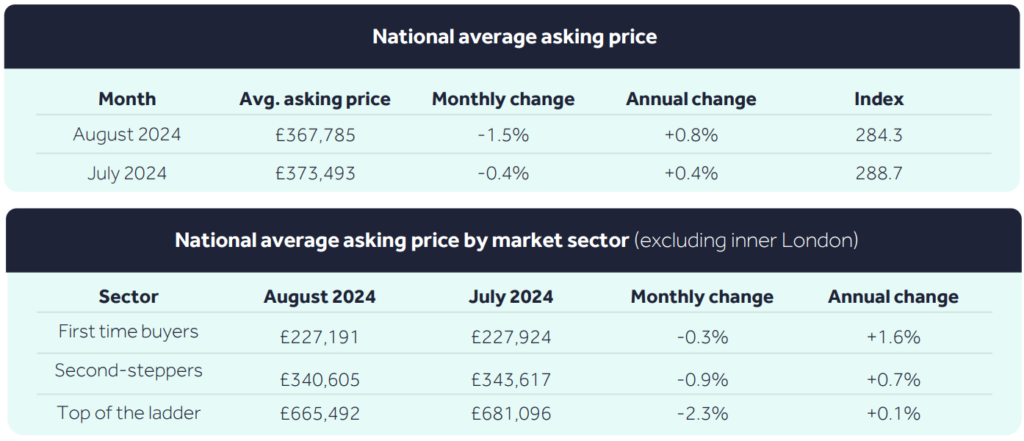
The average asking price for properties entering the market has seen a typical seasonal decline this month, dropping by 1.5% (-£5,708) to £367,785. For the past 18 years, August has consistently witnessed a dip in asking prices, and this year’s decrease aligns with the long-term trend. The summer holiday period often distracts buyers, causing them to delay moving plans, which in turn leads some sellers to price more competitively, especially if they need to sell quickly. However, unlike last summer’s peak-mortgage-rate market, this year’s sellers might benefit from renewed buyer interest.

As noted in our July update, the recent Bank of England rate cut—the first in four years—has accelerated mortgage rate reductions, boosting buyer demand and setting the stage for a promising autumn market. As a result, Rightmove have adjusted their 2024 forecast, now expecting a 1% increase in new seller asking prices instead of the previously anticipated 1% decline.

Tim Bannister, Rightmove’s Director of Property Science, says:

“The recent Bank Rate cut, the first since 2020, has sparked a late summer surge in buyer activity. While mortgage rates haven’t dropped significantly yet, the fact that the long-awaited rate cut has finally arrived, with rates trending downwards, is encouraging for those looking to move. As summer ends, the conditions are favorable for a more active autumn market. This positive response from home-movers, coupled with other encouraging trends, has led us to revise our 2024 forecast. We now predict a slight 1% rise in new seller prices over the year, a modest change from our original 1% decrease forecast, which had anticipated only a minor decline in prices.”

What’s happened since the rate cut?

Since the Bank Rate cut on August 1st, the number of potential buyers contacting estate agents has increased by 19% compared to the same period last year. This is a significant improvement over the subdued market of 2023, which nationally struggled with high inflation and peak mortgage rates. The rise in buyer demand, which was up 11% in July, highlights the immediate and significant impact of the Bank Rate cut.

What about house prices?

This positive shift, combined with other favourable market data, has prompted Rightmove to revise its end-of-year forecast upward, now expecting a 1% rise in new seller asking prices for 2024, instead of the previously predicted 1% decline. The market is likely to see small price increases in autumn, followed by the usual seasonal decreases at year’s end. While uncertainties remain—such as the October Budget, the timing of a second rate cut — the outlook for the rest of the year appears positive. Sales agreements between buyers and sellers are up 16% from last year, and the number of new sellers entering the market is 5% higher than this time last year.

Image from Rightmove August House Price Index

Mortgages

Mortgage rates have also been declining, with the average five-year fixed rate now at 4.80%, a noticeable improvement from 5.82% in 2023, though still high compared to three years ago. Rightmove’s weekly mortgage tracker shows that the best available five-year fixed rate is currently 3.83% for buyers with a 40% deposit, the lowest rate since the period before the mini-Budget in September 2022.

While it may take a few more Bank Rate cuts for home-movers to see a significant reduction in mortgage rates, the immediate boost in buyer sentiment is clear. Both buyers and sellers are more optimistic, as shown by the recent increase in activity.

Curious about your property’s value?

Find out with our free online property valuation.

Recent Articles

July property market update

The property market has seen a notable shift this July as average new seller asking prices drop by 0.4% (-£1,617) to £373,493. This larger-than-usual decrease, compared to the 20-year July average of -0.2%, indicates that sellers are making efforts to capture buyer interest amid the myriad distractions of the season, including the General Election, ongoing sporting events, and the summer holiday period.

Market activity steady despite General Election

Despite the distractions, the property market has remained strong during the General Election campaign. Sales have increased by 15% compared to the same time last year, showing that serious buyers are still moving forward with their plans. Additionally, there are 3% more new sellers compared to last year, highlighting steady market activity.

Buyer demand

Overall buyer demand is stable, but interest from first-time buyers has dropped by 2% due to affordability challenges. First-time buyers are particularly affected by changes in mortgage rates.

The current average five-year fixed mortgage rate is 4.97%, better than the peak of 6.11% in July 2023. However, it remains much higher than the 2.51% average in July 2021, before the Bank of England raised rates 14 times in a row.

Anticipation of interest rate cuts

Many in the market are focused on when the Bank of England will cut its Base Rate, which could happen as soon as August or September. This cut would likely boost home-movers by making mortgages more affordable and improving market confidence as we head into Autumn.

Tim Bannister, Rightmove’s Director of Property Science, says:

“A Base Rate cut is expected to lead to lower mortgage rates, which could be the gamechanger for some would-be home-movers who are being held back by significantly higher monthly mortgage costs. The average five-year fixed rate is still nearly twice as high as it was before the first of 14 consecutive Bank of England rate increases in 2021, with rates staying elevated for much longer than many thought they would. A first Base Rate cut for over four years, together with the new political certainty, could set the scene for a positive Autumn market, with improved affordability and a more confident outlook in the second half of the year.”

Positive outlook for the autumn market

The recent General Election has brought political stability, boosting home-mover confidence. The new government’s focus on housebuilding and planning reform is promising for the housing market. This stability, along with a potential interest rate cut, sets up a strong Autumn market.

In summary, despite challenges, especially for first-time buyers, the outlook is positive. Sellers are lowering prices to attract buyers, and market activity remains strong despite seasonal and political distractions. The expected interest rate cut could further energise the market, benefiting home-movers as we approach the end of the year.

Curious about your property’s value?

Find out with our free online property valuation.

Recent Articles

Demand for houses doubles!

Whether you’re a first-time buyer or a homeowner looking to move up the housing ladder; here’s how the surge in popularity for houses could impact you.

In search of a spacious new home? You’re not the only one. Demand for houses has more than doubled as buyers search for more space due to numerous lockdowns.

Family homes are the most sought-after type of property; with the number of buyers looking to snap one up soaring by a whopping 114% compared with levels typically seen at this time of year between 2017 and 2019.

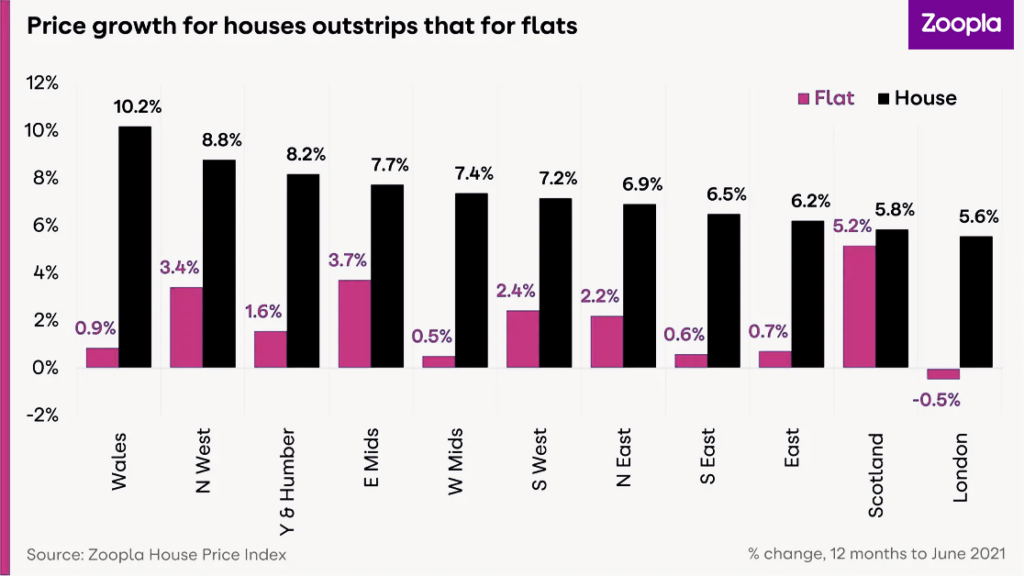
But while demand for all types of houses, from terraced to detached, has more than doubled; the number of buyers looking to purchase a flat has risen by only 34%, according to Zooplas latest House Price Index report.

Why has demand risen?

On the one hand, demand for houses has been rocketed by the stamp duty holiday; with large savings on offer for larger properties (typically houses).

However, the high demand also reflects a surge in buyer interest for more space. The UK lockdowns have made people to reassess their homes and lifestyles. At the same time, the trend for working from home has prompted people to leave city centres in favour of more rural locations; which are more likely to consist of houses rather than flats.

What does this mean for you?

First-time buyers

It could be good news if you’re a first-time buyer looking to purchase a flat rather than a house. The cost of flats has risen much more slowly than property values across the wider housing market during the past year.

It’s worth remembering that there’s significant variation across the regions though. Price growth for flats is up 0.6% in the Southeast during the past 12 months, however prices for houses is up 6.5% in the Southeast. If you’re a first-time buyer eyeing a house, be prepared to face stiff competition. However, with no property to sell, you have an advantage over buyers in a property chain.

It’s important to remember that there are schemes available to help make buying your first home more affordable too; such as first-time buyer stamp duty relief and Help to Buy.

Home-movers

The soaring demand for houses means that if you are planning to sell a property, you could be in a good position to secure a quick sale. You will be more than likely to see it’s value rise during the past year too as price growth for houses has been particularly strong.

However, if you are selling a flat, you may find the gap between the value of your current home and the house you want to purchase has widened in recent months.

How can we help you?

Thinking of selling? Our free online valuation tool enables you to find out how much your existing property is likely to be worth, helping you to plan for your next purchase.

Looking for a new home? With competition intense, you can get ahead by registering with our team to receive alerts whenever a property that meets your criteria is listed for sale. Our advanced search tools also help you find properties in your price range and area that are already listed.

Whether you are buying or selling, in the current fast-paced market, we’re here to give you some friendly local expert advice, speak to a member of our team today.

Recent Articles

Six options to consider if your chain breaks and you miss the stamp duty holiday

After more than a year of driving property prices to new highs during the coronavirus pandemic; the stamp duty holiday has started to taper down. 

The tax break, which has saved buyers up to £15,000 on their house purchases, will now be cut back with the maximum saving capped at £2,500. This is because the nil-rate band – the portion of a property purchase buyers don’t need to pay stamp duty on – will drop from the first £500,000 to the first £250,000. It will stay this way until 30 September, when the nil-rate will be returned to its pre-pandemic level, £125,000.  

House prices have risen to record levels, with a general increase of 13% or £29,000 over the course of the stamp duty holiday according to Nationwide Building Society

Why did the government introduce the stamp duty holiday?

When the stamp duty holiday was introduced in July 2020, it was designed to boost the property market by helping buyers whose finances were affected by Covid. It meant a saving of up to £15,000 for people buying homes.

Landlords and second-home buyers were also able to make use of the tax cut. But they still had to pay the extra 3% of stamp duty they were charged under the previous rules.

What’s the state of the current property market?

Many buyers have raced to meet the deadline; but delays with conveyancing and surveys mean that many will not complete in time due to the heightened demand. This may sound daunting if you’re in the middle of a property chain; but some will even consider pulling their transactions if they have not budgeted to pay the tax. 

Whilst our team do everything within their power to stop this from happening; it sometimes does occur though no fault of anyones. However, it does not always mean that you’ve hit the end of the road. Our team have brainstormed different ways that property buyers could keep going with their purchases and keep their chains from falling apart due to the deadline. 

At Century Residential, we are transparent with our buyers and make it clear from the offset that their offers should not be reliant upon the stamp duty discount. However, if you’re out of time and you can’t afford to buy without the stamp duty holiday, there are a few options that could help.

1. Renegotiate your house price with your seller

If you don’t have the funds to buy your new home and pay stamp duty, you might consider asking the person you are buying from whether they would lower the price. However, this could be risky, as it might lead them to question your commitment to buying the home, we’d advise that you discuss this thoroughly with your estate agent prior. 

Nevertheless, if they are particularly keen to keep things on track, they may be willing to accept your new offer. 

If you have some funds to play with, one option might be asking them to go halves. For example, if you had a £10,000 stamp duty bill; they would take £5,000 off the price and you would foot the other £5,000 yourself. However, their willingness to do this may depend on whether they have a stamp duty bill to pay themselves. 

If you manage to negotiate a new price, you will need to ask your mortgage lender for new documentation which could add time and cost to the transaction.

2. Negotiate with the whole chain

There is a way to get around the problem of having to ask for a discount from someone who isn’t getting one themselves on their onward purchase. This requires some expert negotiating from your estate agent. 

In short, it entails asking every member of the chain to offer a discount that equates to the discount that would be offered by the stamp duty holiday. This is more likely to be accepted [than negotiating with your seller alone], as all parties offer a more affordable discount.

If there is another buyer in a similar situation to you down the chain; it could improve your chances of success.  

3. Move out and rent to keep the chain together  

A common method of holding together a broken chain is by asking the seller whose buyer withdrew, to move into rented accommodation.

By most accounts, the stamp duty holiday has increased house values. So, renting for a few months might mean a chance to get a better deal on the eventual purchase if prices fall. We understand that this is a gamble, as there is no guarantee of where the market is moving next. Nonetheless, now would be the perfect time to do this. Especially with the possibility of prices lowering after the stamp duty holiday. The amount of money spent on rent for six months to a year could be less than [the extra expense of] buying in the increasing market we have seen throughout most of the UK.

If the chain has collapsed, it may be worth investigating whether you can use short-term finance to enable the purchase to continue; however this should be discussed with your mortgage broker.

4. Make sure you complete by the September deadline

If you are upset that you haven’t met the first stamp duty deadline; completing in time for the September cut-off could be the next best thing. There is common perception that the stamp duty holiday will be over on 30 June, but that isn’t the case. There are still reasonable savings to be made until the end of September; but buyers will need to act quickly. 

We suggest that if a buyer starts the process in the next few weeks or so they should hopefully complete before the September deadline.

5. Hold out and hope that house prices fall

If you have had a purchase fall through, biding your time might actually save you money in the event that house prices fall; especially given that house prices have risen more than £20,000 in the past year.

This is significantly true for first-time buyers and landlords, who aren’t relying on money made from the sale of another property to fund their purchase.  

There are already signs that asking prices aren’t increasing as quickly as they were earlier in the year. The most recent government data showed that the average home knocked £5,000 off its value in April; reflecting offers made when buyers thought they had missed the original stamp duty deadline in March.

Another reason why property prices have risen is the supply and demand imbalance in the market. However, that could also be set to change. Sellers who had been cautious to list their home for health reasons or lack of job security could now be tempted. Restrictions fully easing from next month and the economy bouncing back may all provide the confidence that they needed to move.

6. Don’t get too caught up in the hype 

While it is frustrating to have to pay several thousand pounds more for your new home; we urge those that have the funds to proceed to think about their home as a place they will live in and enjoy for many years; rather than as a purely financial asset. 

Whilst most people don’t buy homes as a financial investment – unless you’re a buy-to-let investor. People buy homes as a place to live, raise families, be part of a community, enjoy life, and grow old. Our best advice is to think long-term and buy a home that’s right for your needs; at a price that you can afford and that you plan to enjoy for years to come.

It is also worth bearing in mind that, if you pull out of a transaction, there is no guarantee you will find something else quickly. You need to consider how badly you want the property. With a shortage of stock in some price brackets and areas, you may not find another suitable property anytime soon. 

Let’s have a chat

Whilst the final closure of the stamp duty holiday at the end of September may have no impact at all; we have noticed a different rise in property interest. This is due to other factors, namely the race for space, low supply, accidental savings and low interest rates.

At Century Residential we have helped many people and families during the stamp duty holiday; and we don’t plan to stop making peoples dreams a reality. So, if you’re thinking of selling or buying a property, please get in contact with a member of our team on 01634 570057.

Recent Articles

3 reasons to consider landlord property management

Seeking the ideal tenant for your property? Do you know exactly what is required to comply with industry regulations as a landlord? Not to worry – here at Century Residential, we can handle all your queries and concerns with our reliable landlord property management services. We offer 3 different categories of services depending on your preference including – let only, let only with rent collection or fully managed.  

If you require property management within Gillingham, Kent, Medway or Maidstone areas, then our expert team can help you. The following are 3 main reasons you can trust us with your biggest asset.  

Fully Managed Operations

Leave it to the trusted professionals here at Century Residential to handle and manage all your letting needs. Give yourself complete peace of mind by working with a supportive, experienced, and qualified team who will be able to seamlessly meet your requirements. From finding and assessing a suitable tenant for your property to preparing the tenancy agreements and more, we provide fully managed operations from start to finish.     

Customised Personal Attention

As a large portion of our clients come to us through recommendation, we aim to always deliver a customised experience. We take great pride in not only meeting, but exceeding the expectations of our landlords. All of our marketing methods are completely customised to our clients requirements. We aim to deliver 100% of our attention to your needs so that the whole procedure can run professionally and smoothly, and all individuals involved can be completely satisfied with the given agreement.

Local Experts

Landlord property management is most effective when executed by local experts. As an independent firm, we constantly seek opportunities to foster community involvement. When you choose to hire locally for your property management, this allows for local expertise to be brought into the heart of the operation.

Are you in need of reliable landlord property management services? Here at Century Residential we aim to find you a suitable tenant and create a fair agreement without any fuss. Contact our experienced and enthusiastic team today – we look forward to speaking with you. 

Letting agent checklist: top tips to keep in mind when choosing the right agent

Teaming up with the right letting agent can make a world of a difference when it comes to finding the best property for you. Whether you’re brand new to the world of renting or you’re planning your next big move, our team at Century Residential fully understand the importance of finding the ideal property and making the process as smooth and as stress-free as possible.

So how can you be sure that you’ll be in the best hands when it comes to renting a property? Consider some of our top tips to keep in mind when seeking out the right letting agent for you. Here at Century Residential, our team is proud to offer you the following qualities in all of our services.

Expert Local Knowledge

Every letting agent should have full knowledge of the area surrounding the property you are interested in. Our team of experienced property professionals boast extensive local knowledge of Gillingham, Rochester, Chatham and the wider Medway & Kent area.

Interested In Your Needs & Budget

Finding the right home means finding a place that fits your requirements and your desired budget. Here at Century Residential, we understand how important it is to always put the needs of our clients first, and with their ideal budget in mind.

Fully Reliable

Once you’ve found your perfect property to rent, there is still a lot to be done. Our dedicated, local Kent staff will be with you every step of the way until the entire process is complete. From credit checking to employment status and all of the necessary paperwork in between, we work alongside you to help make sure you get the property you deserve. 

Are you looking to buy or rent a property? Get in touch with Century Residential Estate Agents to find out how we can help you today.

Home staging | Present your home for sale or let

The start of a new year typically brings a lot more properties to the market. We felt it would be a good idea to give you some tips on how to get the staging of your property right.

1. That lived in feel
We advise to keep your home clean and tidy, but ensure that your home has a “lived in” feel. Too much furniture can make your home look over-crowded, but too little furniture can give your home a cold feeling.

2. Don’t Underestimate The Power Of Flowers
Whilst we wouldn’t encourage you to go over the top on flowers the odd bunch could prove to be effective. Not only will give off a lovely scent, it will also help with the photography too.

3. Selling a Lifestyle
Remember, you’re not just selling a home, you’re selling a lifestyle. Don’t over do it with furniture and hide the clutter. Viewers will always want to see how space will work for them, over doing it, or leaving clutter around could make it hard for viewers to see the space in any other way.

4. Temperature
It’s important that your home heated well, especially in the winter! If your home is cold, viewers won’t hang around! Equally, if your home is too hot, it could look like you’re trying to hard and be off putting.

5. Lighting
Make sure that there is sufficient lighting to your rooms. We would recommend ensuring that you allow as much natural light into your home as possible, pulling back curtains and tying up blinds. If you are relying on artificial light we would recommend ensuring that all lights are switched on before a perspective viewer arrives.

If you are thinking of selling or letting your home and would like more tips on how to present it, please contact our office on 01634 570057 or e-mail us at medway@crrealestate.flywheelsites.com

From Century residential Estate Agents in Gillingham, Kent

EFC | Energy Efficiency Regulations | 2015 | 2018

The Energy Efficiency (Private Rented Property)(England and Wales) Regulations 2015 (the Regulations) come into force on from 1 April 2018. Properties rented out in the private sector will be required to have an Energy Performance Certificate (EPC) with a minimum energy performance rating of ‘E’.

It will be unlawful to rent out a property which does not have a minimum E rating unless the property has an exemption. While this seems to be an onerous requirement for landlords to comply with, it is not. Only appropriate, permissible and cost-effective improvements are required. At the moment, if the improvements cannot be funded or the landlord has carried out all possible improvements and the property still has an F rating, for example, exemptions will apply.

Breaches of the regulations could result in a civil penalty of up to £4,000.

Which properties are covered by the regulations?

The Regulations apply to domestic privately rented properties in England and Wales, let on relevant tenancies including those let on assured shorthold tenancies, which are legally required to have an Energy Performance Certificate (EPC)

Relevant tenancies include:

An assured tenancy (including an assured shorthold tenancy)
A regulated tenancy defined in the Rent Act 1977;
A domestic agricultural tenancy
A property is legally required to have an EPC where an owner or landlord has, on sale, letting or construction of a property been required to make an EPC available to the prospective buyer or tenant. A new EPC is also likely to be necessary if a building is modified to have more or fewer parts than it originally had and the modification includes the provision or extension of fixed services for heating, hot water, air conditioning or mechanical ventilation.

This means that where a property is let on a relevant tenancy type but is not legally required to have an EPC, the Regulations will not apply.

Where a property is legally required to have an EPC but is not let on a relevant tenancy, the Regulations will also not apply.

The Regulations will apply to all relevant new and renewed tenancies from 1 April 2018 and for all existing tenancies on from 1 April 2020.

Therefore from 1 April 2018, you will need an EPC with a rating of at least E for all new properties let and any tenancy renewals. This includes when a fixed term expires and a statutory periodic tenancy begins after the 1 April 2018.

What improvements does the landlord need to carry out?

If the property the landlord wishes to rent out currently has an F or G rating on a legally required EPC, then they must carry out energy efficiency improvements to bring the property up to an E rating before the property can be rented out unless the landlord qualifies for an exemption and registers that exemption on the Public Exemptions Register.

The requirements are not as onerous as they might seem at first glance. The regulations require only appropriate, permissible and cost-effective improvements to be carried out. Landlords are only required to carry out improvement works which can be completed at no cost to themselves. The main sources of no cost funding are the Green Deal, Eco help to heat funding and local authorities home energy efficiency grants. If the work cannot be carried out within the Green Deal golden rule then, an exemption will apply. This is under review any may be replaced with a cost cap in future.

Exemptions

Landlords will be eligible for an exemption from reaching the minimum standard where they can show that one of the following applies:

All ‘relevant energy efficiency improvements’ have been made – Where the landlord has made all the relevant energy efficient improvements that can be made and the property remains sub-standard.
Measures cannot be wholly financed – Where the landlord is unable to access relevant no cost funding to fully cover the cost of installing the recommended improvement(s).
Third Party Consent Exemption – Where the landlord is obliged to obtain a third party’s consent to undertake relevant improvements and consent was denied, or was provided with unreasonable conditions
Occupying Tenant Consent Exemption – Where the landlord requires consent from an occupying tenant, and the tenant withholds that consent. A tenant’s consent may not be required where the tenancy agreement allows the landlord to enter to carry out improvements (not just repairs).
Property Devaluation Exemption – Where measures required to improve the property are shown by a suitably qualified independent surveyor, as expected to cause a capital devaluation of the property of more than 5%. Only those measures that are expected to cause such devaluation would be exempt from installation.
Wall Insulation Exemption – no requirement to install wall insulation under the Regulations where the landlord has obtained written expert advice advising that it is not an appropriate improvement due to its potential negative impact on the fabric or structure of the property (or the building of which it is part).
Recent Landlord Exemption – in certain circumstances where a person becomes a landlord suddenly, a temporary exemption form the prohibition on letting a sub-standard property will last for six months after the date they became the landlord.
In all cases the exemption must be registered on the National PRS Exemptions Register.

Compliance

Local authorities will enforce compliance with the regulations. Where a local authority suspects that a landlord with a property in scope of the regulations is not compliant or has not sufficiently proved and exemption, the local authority can serve a compliance notice on the landlord requesting further information.

If the information is not provided or is provided and is not sufficient to provide compliance, the local authority may then issue a penalty notice. Penalties for a single offence can be levied up to £4,000 depending on the offence. Further penalties may be awarded for non-compliance with the original penalty notice where a landlord continues to rent out the property. These penalties will be cumulative up to a maximum of £5,000.

Flats and Bedsits

For the purposes of the Regulations flats mean self-contained units within a building. Flats require their own individual EPC at the point of sale or letting. If a flat has its own mandatory EPC as well as the building containing the flat, then it is the EPC for the flat (not the building) which shows whether the minimum energy efficiency standard is met.

Non-self-contained units such as bedsits do not normally require an individual EPC. However, if the house containing the bedsit has been sold the whole property needs to have an EPC. In those cases, the Regulations will apply and the building will need to have an energy rating of E or above to allow the bedsit to be legally rented out.

Next Steps

Carry out a review of all properties you are renting out and check the EPC rating.
If the rating is E is above, you need take no further steps beyond noting the date of expiry so that a new EPC can be obtained when required.
If the rating is F or G, consider;
a. what works you need to carry out to meet the energy efficiency requirements can relevant improvements be installed at no cost to you? If no, register an exemption on PRS Exemptions Register.
b. how and when you can carry the works to meet the requirements Consider whether any other exemptions might apply as above. If so, register an exemption on PRS Exemptions Register.
c. if no exemptions apply consider by what date you will need to obtain the new rating to comply e.g. new tenancy or renewal date of existing tenancy.

Book A Valuation